
What is an eInvoice in the UAE?
An eInvoice is structured invoice data issued and exchanged electronically between supplier and buyer and reported electronically under the UAE eInvoicing framework. A PDF, scanned invoice, image or email by itself is not an eInvoice.
The UAE framework uses accredited electronic channels and service providers to support structured invoice exchange and reporting.
Which transactions are currently in scope?
The current framework covers in-scope B2B and B2G transactions, subject to the exclusions defined in the relevant ministerial decisions.
B2C transactions are currently outside the mandatory eInvoicing system until a future implementation date is determined.
UAE eInvoicing implementation timeline
| Category | ASP appointment deadline | Mandatory go-live |
|---|---|---|
| Large business category (AED 50m and above under the rollout framework) | 30 October 2026 for the category covered by the extension | 1 January 2027 |
| Businesses below AED 50m annual revenue | 31 March 2027 | 1 July 2027 |
| In-scope Government Entities | 31 March 2027 | 1 October 2027 |
What changed for large businesses?
The original ASP appointment deadline was 31 July 2026. In May 2026, the Ministry of Finance announced an extension to 30 October 2026 for the affected large-business category.
The mandatory implementation date remains 1 January 2027.
Why is an Accredited Service Provider required?
Accredited Service Providers form a core part of the UAE eInvoicing model. The Ministry of Finance maintains and periodically updates the official list of accredited providers.
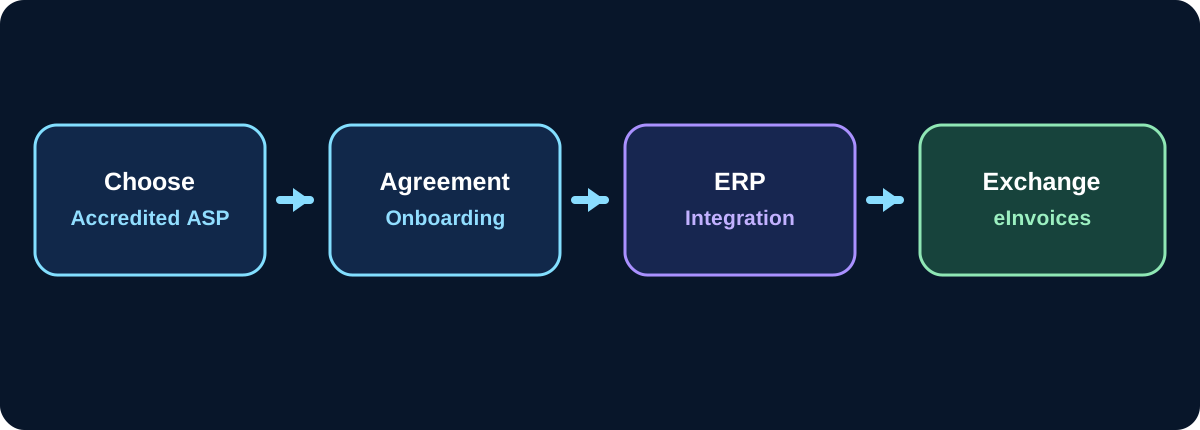
Businesses select an appropriate ASP, complete the commercial and onboarding process and prepare their systems for electronic invoice exchange.
How should you choose an ASP?
- ✓ Confirm that the provider appears on the official accredited list.
- ✓ Review ERP integration capabilities.
- ✓ Compare total cost rather than subscription price alone.
- ✓ Assess technical support quality.
- ✓ Review invoice status and error visibility.
- ✓ Check scalability for future invoice and entity growth.
- ✓ Ensure a clear submission and response audit trail.
NOZOM .cloud can simplify the onboarding journey
Instead of contacting providers separately and managing forms, agreements and onboarding manually, businesses can initiate the eInvoicing service request through NOZOM .cloud.
Customers can provide company information, choose the appropriate service option, submit required documents and follow the request from their NOZOM .cloud account.
We work with accredited service providers under commercial arrangements designed to offer competitive options for NOZOM .cloud customers and simplify the onboarding and integration process.
Portal use or ERP integration?
Using the provider portal directly may suit some businesses, but it can also mean re-entering invoice information that already exists in accounting and sales systems.
With ERP integration, invoices can originate inside the business system and move through validation, submission and status tracking without unnecessary duplicate entry.
What should your business do now?
- ✓ Identify the rollout phase that applies to your business.
- ✓ Review customer, supplier and tax master data.
- ✓ Select an appropriate accredited service provider.
- ✓ Decide between manual portal use and ERP integration.
- ✓ Start onboarding early rather than waiting for the deadline.
- ✓ Test rejection, correction and resubmission workflows before mandatory go-live.